
Mailing List Validation sounds like an email problem. For teams mailing 30,000 records or more, it is really a customer file problem. Smart marketers start with a real file check at IMDataCenter before the next renewal, donor appeal, or win back drop.
According to email list decay data, at least 23% of an email list degrades each year. That stat speaks to digital data, but the lesson carries across channels. When one part of the file goes stale, the rest often follows.
I have seen this for years. A team cleans email before a campaign, yet the mail file still holds old addresses, disconnected phones, and duplicate households. That is when data hygiene stops being a back office task and starts protecting margin.
Why Mailing List Validation Matters More Now
Bad data rarely stays in one lane. One weak contact signal often points to a broader file issue.
Many teams suppress bad email but keep mailing the same stale household record. That gap creates waste across channels. It also hides the true cost of file decay.
Here is the part most people miss. Most direct marketing problems do not start with the channel. They start when customer data drifts and nobody measures the damage soon enough.
What Mailing List Validation Really Means
For most teams, this starts with a definition problem. They hear mailing list validation and think only about email checks or a mailing list validation online tool.
That view is too narrow. In practice, Mailing List Validation means checking the health of the customer data you already own. The goal is simple. Help every channel work from a cleaner map.
It Is More Than Bounce Cleanup
Validation is not just removing records after they fail. Good validation catches bad data before it wastes budget.
For email, that includes syntax, domain checks, and risky addresses. For direct mail, it includes mover processing, address standardization, deceased suppression, and deliverability checks. For phone, it means knowing if the line is valid, disconnected, wireless, or landline through services like phone append.
It Is Not The Same As Suppression
Suppression handles known exclusions. Validation tests whether the record is still usable.
Think of a chart on a boat. A warning buoy helps, but you still need an updated chart. Suppression is the buoy. Validation is the chart.
How Data Drift Raises Direct Mail Waste
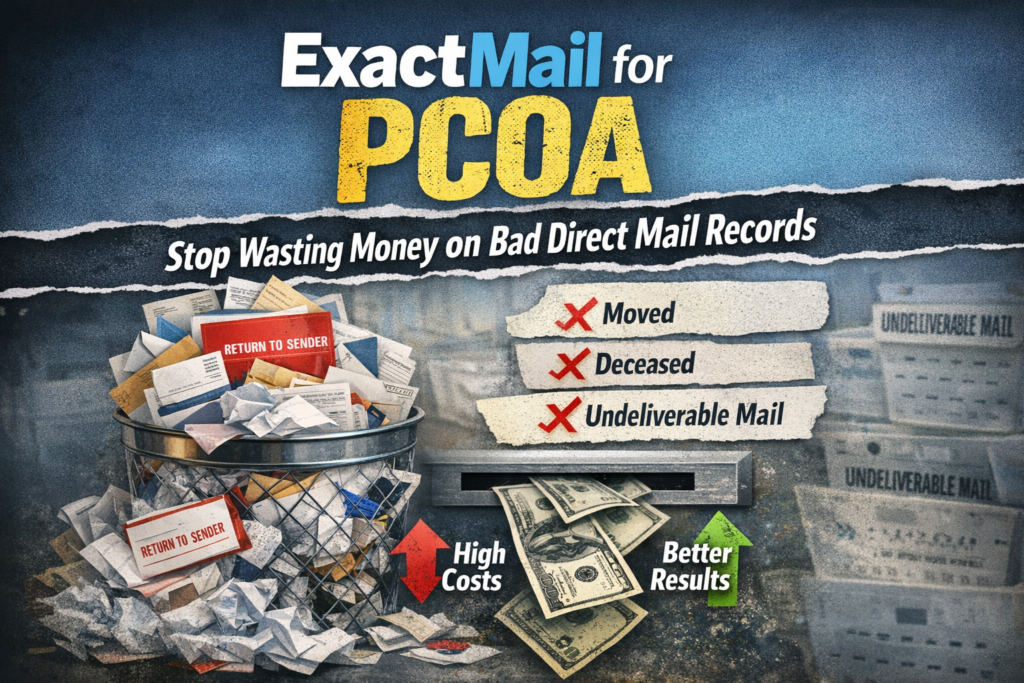
A customer file decays quietly. People move. People pass away. Phone numbers change. Emails go inactive.
Waiting does not preserve data. It lets the file drift off course. That is why regular updates from PCOA processing matter for active mail programs.
Approximately 15% of most customer files contain old or incorrect postal addresses. Your file may be better or worse. Even so, most large files carry enough drift to justify inspection before the next campaign.
The Waste Shows Up In Stages
- Undeliverable pieces eat print and postage
- Bad addresses weaken household matching
- Disconnected phones reduce follow up efficiency
- Old emails hide engagement signals
- Duplicate records distort reporting
An agency owner told me recently that a large client file had gone stale in ways nobody saw on the dashboard. The mail did not fail all at once. It failed one expensive piece at a time.
How Mailing List Validation Works In The Field
Good validation follows a process. It is not one app, one export, or one last minute drill.
Here is a practical workflow for organizations with real mail volume and multi channel campaigns. Teams that use data append services often perform better because they build a maintenance habit.
- Audit the file for gaps, duplicates, and format problems
- Run PCOA to update movers and include NCOA and deceased processing
- Check deliverability signals and address quality
- Append missing phone or email when it supports response goals
- Segment the cleaned file by campaign goal and recency
- Repeat on a schedule instead of waiting for visible failure
When Should You Validate
The best timing is practical. It is not theoretical.
- Before a major direct mail campaign
- At the point of capture when possible
- After long periods of inactivity
- Before renewal, cross sell, or donor reactivation efforts
- On a recurring schedule through the year
If you are searching for a mailing list validation free option, use it with care. Free tools may catch obvious issues, but they rarely fix the deeper file drift that hurts deliverability and acquisition cost.
Email Validation And Postal Validation Are Not Separate Problems
Digital teams and mail teams often work from the same CRM. Too often, they act like they manage different worlds.
They do not. The same stale record can miss the inbox, miss the mailbox, and miss the call center. That is why an email append discussion should never happen in isolation.
If a donor or policyholder record cannot support a valid email, it may also need postal review, phone verification, or demographic refresh.
Related Terms That People Mix Up
| Function | What it does | Best use |
|---|---|---|
| Email validation | Checks if an email record appears valid and mailable | Pre send cleanup |
| Bounce management | Removes or suppresses failed email after sending | Post send maintenance |
| Postal address verification | Checks postal address quality and deliverability | Mail file cleanup |
| Mover processing | Updates movers and suppresses deceased records | Ongoing file accuracy |
| Enrichment | Adds missing contact or profile fields | Response improvement |
Many marketers look for an Address verification tool or even Free address verification USPS options. Those can help with a narrow task. Results improve most when validation connects to ongoing file maintenance.
PCOA And NCOA Are Part Of A Smarter Hygiene Cycle
Too many marketers still treat mover data like a once a year scramble. Then they wonder why mail waste creeps back.
PCOA is the stronger annual cleanup because it includes NCOA inside the workflow. It also adds proprietary mover intelligence and deceased processing. For a closer look at the process, see how automated PCOA fits active mail programs.
NCOA should then run quarterly or more often between annual PCOA passes. That order matters. PCOA comes first.
| Feature | NCOA | PCOA |
|---|---|---|
| USPS Change Of Address | Yes | Yes, included |
| Proprietary Mover Data | No | Yes |
| Deceased Processing | No | Yes |
| Additional Mover Intelligence | No | Yes |
| Recommended Frequency | Quarterly or more | Annually |
| Best Use | Ongoing maintenance | Full annual cleanup |
PCOA is typically 80% or more accurate on identified mover records, depending on file quality. One stale address can turn a profitable segment into a costly guess.
Validation Gets Stronger When You Add The Right Data
Sometimes cleaning is not enough. You also need to fill in what is missing.
That is where enrichment helps. CIMA adds demographics, property elements, and auto elements. It does not process moves. You can see how CIMA supports segmentation after address quality has been handled through PCOA.
Useful Append Steps After Cleanup
- Email append and validation for multi channel reach
- Phone append for follow up and contact recovery
- Phone disconnect processing to understand line status
- Reverse phone append for records that start with a number
- Demographic enrichment for sharper targeting
Wireless phone append can match up to 85% of input data, including DNC numbers for non profit and political campaigns. That rate is around 60% when DNC numbers are omitted.
Reverse phone append match rates can reach 90%. It can also append demographics such as year of birth and property data. Clients pay only on matched records, not on input.
What Strong Operators Do Differently
The best marketers do not ask if the file is perfect. They ask what waste is hiding inside it today.
Since 2009, Brooks Integrated Marketing has helped organizations improve customer data and campaign performance. Clients typically see 10% to 30% improvements in data quality. Many also cut wasted direct mail spend by 12% to 20% once recurring processing is in place.
A Practical Standard For Large Files
If I were setting policy for a national insurance team, agency group, or fundraising operation, I would keep it simple.
- Run PCOA annually based on mailing cadence
- Run NCOA quarterly or more often between annual passes
- Validate email before major sends
- Use phone and demographic updates to recover response opportunity
- Review file health before every major campaign
That rhythm beats chasing a Mailing list validation app every time a deadline gets close. Better data habits win because they stop waste before the budget leaks out.
Some teams start with Email list validation free checks or a Sidemail email validator. Those tools may help at the edges. They do not replace a full file review.
Frequently Asked Questions
What is email list validation / mailing list validation?
Mailing list validation means checking whether the records in your customer file are still usable for outreach. In email, that includes invalid or risky addresses. In direct mail, it means address quality, mover updates, deceased suppression, and related file corrections that protect deliverability and response.
Why is mailing list validation important?
Because stale records drain money quietly. A bad email hurts engagement and deliverability, while a bad postal address wastes print and postage. I have seen many teams fix one channel and ignore the rest of the file, then wonder why ROI still feels soft.
How does mailing list validation work?
It works by auditing the file, correcting what can be corrected, suppressing records that should not be mailed, and enriching missing fields that improve reach. A good process may include Postal address verification, PCOA, phone append, and email checks tied to actual campaign timing.
What are the benefits of validating an email list?
You reduce bounces, improve inbox placement, and get a clearer picture of who is still reachable. More important, email decay often flags broader file drift, so teams that catch it early can also protect direct mail performance before stale household records raise waste.
When should you validate a mailing list?
Before a major campaign, after long inactivity, and on a recurring schedule through the year. If someone is relying on Mailing list validation online searches, Sidemail email validator tests, or a Mailing list validation free check right before deployment, they are usually reacting too late.
Test Your Data For Free
If your email file is decaying, your postal file is probably drifting too. A free file review can show where waste is hiding, what can be corrected, and how much deliverability you may recover before the next campaign.
That is the work IMDataCenter has done since 2009 for organizations that depend on accurate customer data to drive response. Better Data. Better Marketing. Better Results.
About The Author
Brooks Hall is the founder and CEO of Brooks Integrated Marketing and the builder of the IMDataCenter platform. Since 2009 he has helped organizations across the country improve marketing performance through better customer data. When he is not running files, you will find him navigating the Everglades, where he goes by TheMapster.